
Vietnam is a dream destination for digital nomads and backpackers who often prefer “slow travel” without fixed end dates. However, the question of whether you need a confirmed flight out of the country before you even arrive is one of the most debated topics in travel forums. If you are planning a trip, understanding the requirements for an onward ticket Vietnam is essential for a stress-free journey.
As of 2026, Vietnam’s entry requirements have become more digitized, but enforcement remains a mix of official law and airline policy. This article breaks down everything you need to know to ensure a smooth entry regarding your onward ticket Vietnam.
What Is an Onward Ticket?
An onward ticket is official proof that you have a confirmed departure scheduled before your legal stay in the country expires. While many travelers assume this must be a return flight to their home country, the requirements are actually much more flexible. Any ticket that takes you across a Vietnamese border to a third country—be it Thailand, Cambodia, or Singapore—qualifies as proof of onward travel. When searching for an onward ticket Vietnam, remember it only needs to show you are leaving the territory.
In the eyes of immigration and airlines, this document serves as a financial and logistical guarantee that you will not overstay your visa. It typically includes a Passenger Name Record (PNR) or a booking reference number that can be verified in a global distribution system. For those entering by land, the definition becomes murkier, as many authorities specifically look for air travel documentation rather than bus or train bookings.

Read more: What is onward ticket? Who Needs an Onward Ticket and When?
Does Vietnam officially require an onward ticket?
The official stance of the Vietnamese government depends significantly on the specific entry method you are using. In 2026, the policy is categorized into three main streams:
- Visa Waiver (Exemption): If you are entering under a visa exemption (common for citizens of the UK, Germany, France, Italy, and ASEAN nations), an onward ticket Vietnam is legally mandatory. Because you are entering without a pre-screened visa, the onus is on you to prove that you are a genuine tourist with a departure plan within the 45-day window allowed. Without this, you are technically in violation of entry conditions from the moment you land.
- E-Visa Holders: For those holding the popular 90-day E-visa, the requirement is technically on the books but rarely enforced by immigration officers. Since you have already provided an intended date and port of exit on your application, the government considers your intent to leave as “declared.” However, the lack of a physical onward ticket Vietnam still leaves you at the mercy of individual officer discretion.
- Visa on Arrival (Approval Letter): Travelers using a pre-arranged approval letter (now mostly limited to business or specialized travel) fall into a similar category as E-visa holders. While the letter grants you permission to board, the underlying immigration law still requires you to have a means of exit.
Read more: Onward Ticket India – Everything You Need to Know Before Travel
Airline vs Immigration — Who actually checks?
Understanding the dynamic between the airline and immigration is the most critical part of planning your trip. They have two very different motivations for checking your documents.
The Airline: Your biggest “hurdle” is almost always the airline check-in agent at your departure airport. Airlines are strictly regulated and face heavy fines (often exceeding $5,000) if they fly a passenger to a country where they are denied entry. Consequently, check-in staff use a system called TIMATIC, which lists the requirements for every destination. If TIMATIC states that you need an onward ticket Vietnam, the agent has the authority to deny you boarding right there at the counter. They are far more likely to be rigid because their job is on the line.
Immigration: When you land in Hanoi, Da Nang, or Ho Chi Minh City, the immigration officer’s primary focus is on your visa validity and passport stamps. While they have the legal right to ask for your exit plans, they typically only do so if something about your travel history raises a “red flag,” such as having multiple back-to-back entries into Vietnam. If you are a standard tourist, they often process your entry in seconds without asking for an onward ticket Vietnam.
Who is most likely to be asked for an onward ticket?
While anyone can be asked, certain factors significantly increase your chances of being stopped for a documentation check:
- Visa-Exempt Travelers: As mentioned, if you haven’t paid for a visa in advance, you are the primary target for checks.
- Low-Cost Carrier Passengers: Airlines like AirAsia, VietJet, and Jetstar are notorious for strict document verification. They operate on thin margins and are extremely aggressive about avoiding “deportation” costs, often making an onward ticket Vietnam a non-negotiable requirement.
- Regional Transit Hubs: If you are flying into Vietnam from a major hub like Singapore, Kuala Lumpur, or Bangkok, you are statistically more likely to be checked. These routes are heavily used by “visa runners,” and agents there are trained to look for proof of departure.
- One-Way Ticket Holders: If your booking into Vietnam is a simple one-way fare, the system often flags you automatically for manual review at the check-in desk, where they will ask for your onward ticket Vietnam.
What happens if you don’t have an onward ticket?
If you arrive at the airport and realize you don’t have proof of onward travel, the situation can escalate quickly. Depending on the airline and the specific agent, you will likely face one of the following scenarios:
- Forced On-the-Spot Purchase: The agent may point you toward a ticketing kiosk and tell you that you cannot check in until you show a confirmed booking. This often results in travelers buying the most expensive, last-minute flight just to satisfy the onward ticket Vietnam rule.
- The “Indemnity” Waiver: In very rare cases, some airlines might allow you to sign a waiver stating that you take full financial responsibility if Vietnam denies you entry. However, in 2026, most major carriers have phased this out in favor of strict compliance.
- Entry Denial: If you manage to board but are stopped at Vietnamese immigration without a ticket, you could be detained in a holding area. You will likely be required to buy a flight out immediately under the supervision of an officer or be deported on the next available flight back to your origin.
How to get an onward ticket (Safely & Legally)
For travelers who value flexibility and don’t want to lock in their plans months in advance, there are several legitimate strategies to satisfy the requirements without losing money.
Use an Onward Ticket Service
This has become the gold standard for long-term travelers and digital nomads. Professional services like Onward Free act as specialized travel agents that facilitate genuine, verifiable flight reservations in your name for only 9$. These services use agency credentials to hold a real seat on a commercial flight, providing you with a legitimate PDF confirmation and a valid Passenger Name Record (PNR).
Because these are actual reservations rather than fakes, an airline agent can verify the booking in their global distribution system, where it will appear as a “Confirmed” or “Valid” status. The service automatically handles the cancellation of the reservation after 48 hours, allowing you to bypass the massive upfront cost of a full flight while remaining fully compliant with the onward ticket Vietnam standards of both airlines and immigration.
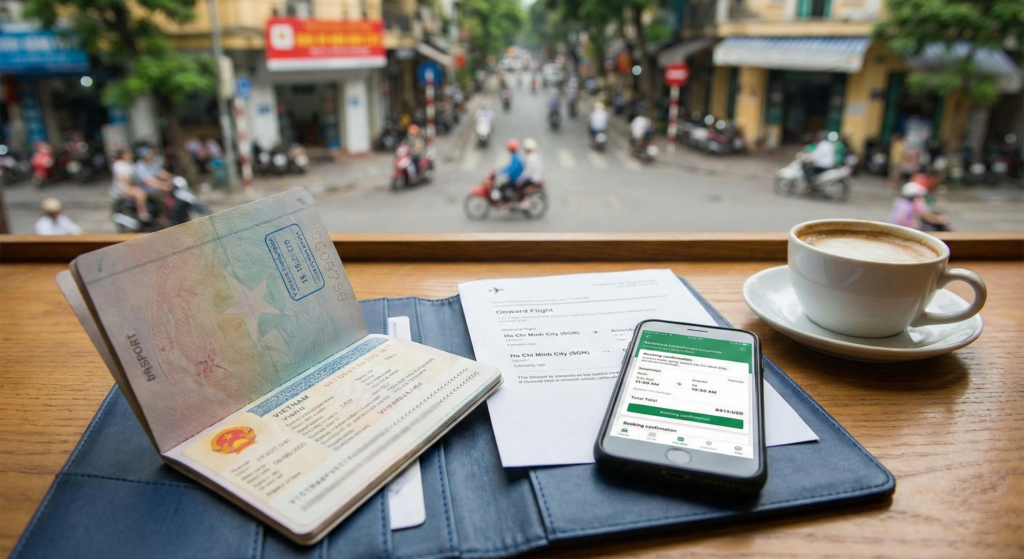
Buy a Refundable Ticket
If you have a high enough credit limit on your card, you can purchase a fully refundable “Flex” or “Business” class ticket directly from a major carrier like Vietnam Airlines or Qatar Airways. This strategy involves buying a high-tier ticket a day before your trip, presenting the confirmation at the check-in counter as your onward ticket Vietnam, and then logging into the airline’s website to request a full refund once you have cleared Vietnamese immigration.
While this is a foolproof legal method, it does require a significant temporary outlay of cash, often exceeding $600. Furthermore, you must read the fine print carefully to ensure the ticket is “fully refundable to the original payment method” rather than just a travel credit, and be prepared for the refund process to take anywhere from 15 to 30 days to hit your bank account.
Use a 24-Hour Free Cancellation Policy
Many global booking platforms and major US-based airlines offer a 24-hour “cooling-off” period, which is a consumer protection policy allowing travelers to cancel any flight for a full refund within a day of booking. To make this work, you must time your purchase perfectly by booking the flight just a few hours before you depart for the airport.
This provides you with a valid confirmation to show during check-in and boarding. Once you are in the air or immediately upon landing in Vietnam, you can cancel the booking through the airline’s portal to trigger an automatic refund. This method carries the highest risk, as it relies on having reliable internet access and avoiding significant flight delays that could cause the 24-hour window to expire before you can cancel, leaving you stuck with the full cost of the ticket.
Tips to avoid problems at check-in or immigration
- Hard Copies are Essential: While digital PDFs are usually accepted, a dead phone battery or a lack of airport data can lead to a crisis. Always have a printed copy of your onward ticket Vietnam in your carry-on bag.
- Sync with your Visa Dates: If you have a 45-day exemption, your onward ticket must be for day 45 or earlier. If it is even one day after your legal stay, the airline will reject it as “invalid proof.”
- Avoid “Fake” Generators: Some websites offer to create a “fake” ticket for free. In 2026, airlines are much better at spotting these. If an agent checks the PNR and it doesn’t exist in the system, you could be flagged for document fraud, which is far more serious than simply not having an onward ticket Vietnam.
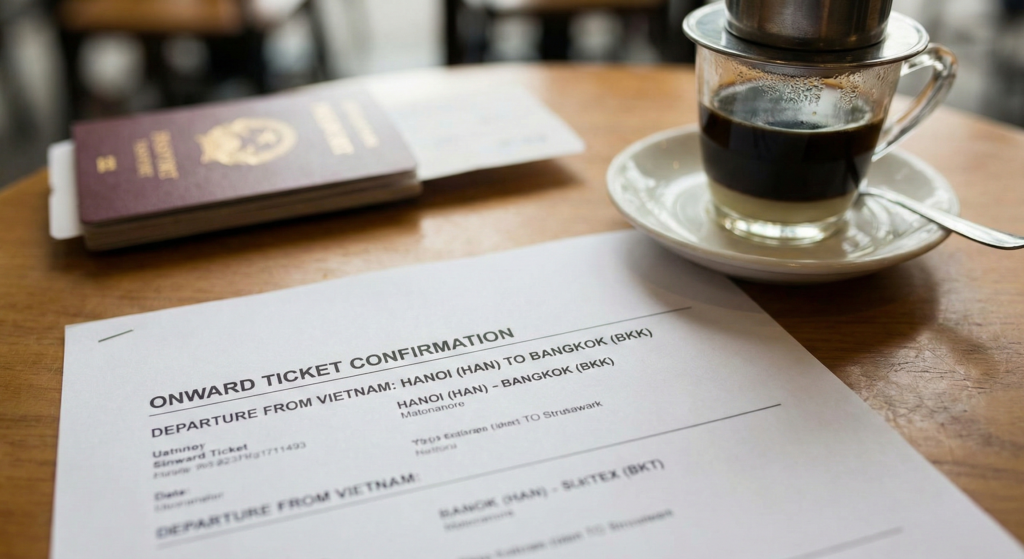
Frequently asked questions (FAQ)
Q: Can I show a bus ticket to Cambodia instead of a flight?
A: Legally, a bus ticket should suffice as “proof of departure.” However, many airline systems are only designed to verify flight PNRs. If your check-in agent is being difficult, they may refuse a bus ticket. Using a flight-based onward service is generally the “path of least resistance” to secure an onward ticket Vietnam.
Q: Does the onward ticket have to be to my home country?
A: No. You just need to prove you are leaving Vietnam. A flight from Saigon to Bangkok or Hanoi to Vientiane is perfectly acceptable.
Q: What if I plan to stay for the full 90 days on an E-visa?
A: You still need to show a ticket that departs within that 90-day window. If you don’t know where you want to go next, use a “rented” ticket service to buy yourself time.
Conclusion
Navigating the logistics of an onward ticket Vietnam doesn’t have to be stressful for travelers. While the chances of being checked at immigration are relatively low for E-visa holders, the risk at the airline check-in counter is high enough to warrant careful preparation. By spending a few dollars on a legitimate onward ticket service or utilizing a refundable fare, you can ensure that your arrival in Vietnam is characterized by excitement rather than an expensive, last-minute scramble at the airport.



0 Comments